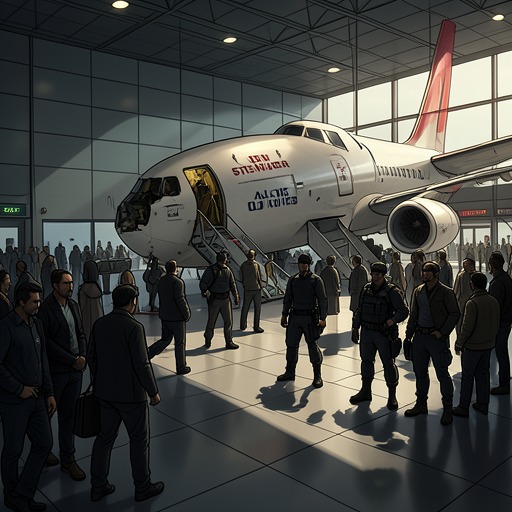
Ahmed Najjar’s phone
All the Old KnivesAhmed Najjar’s phone is both a lifeline from aboard the hijacked aircraft and a source of doubt about who is speaking through that lifeline. Messages attributed to the courier give the intelligence team concrete information about the passengers, the attackers, and a possible rescue approach. But the phone’s identifying code does not prove that Ahmed Najjar remains its user: as the messages accumulate, the team recognizes that the last one has a different author. The device therefore shifts from a conduit for intelligence to evidence of a possible breach.
Identity and Function
The phone belongs to Ahmed Najjar, an agent traveling aboard the aircraft during the hijacking. Five hours after the hijacking begins, a text from him reaches an emergency Langley number and is forwarded to Vick. The contact is exceptional because the team has a source inside the plane, but it is also mediated: the information arrives through a phone and a chain of forwarding, not through direct conversation with the people in the room.
The first account is compressed and operational. It reports four attackers and two guns, locates children in first class, and distinguishes the passengers seated on opposite sides of economy. Ahmed says he is aft with the Muslim passengers. He reports that two women are in critical condition, that the water is running out, and that the loss of power means there are no cameras. He also suggests an assault through the aircraft’s rear undercarriage. Each detail gives the team a different kind of information: the distribution of passengers, the urgency of their physical circumstances, the limits on surveillance, and a possible point of entry.
The phone thus carries more than a general report that the aircraft is in danger. Its messages make the plane legible in fragments: where people are seated, what resources are failing, and what the attackers may have prepared for. At the same time, the fragments are shaped by the circumstances of their transmission. The team must interpret brief written messages without being able to ask Ahmed what he means or verify who is holding the device.
The Messages and the Rescue Proposal
Vick presents Ahmed as a courier who is traveling on a Lebanese passport but belongs to their side. His presence aboard the flight seems an extraordinary stroke of luck. The team reads Ahmed’s file while considering how much weight to give the messages: he speaks Arabic and Farsi, but, as the narrator notes, he has spent the previous six years largely placing dead drops, is fifty-eight, and is nearing retirement. That assessment introduces a gap between the value of his position and the team’s confidence in his ability to influence events. His phone can transmit observations, but it cannot make him a strongman capable of controlling the hijackers.
A later message makes the possible rescue plan more troubling. It says that the attackers have a camera on the undercarriage, characterizes the attack plan as only a rough idea, and warns that the hijackers know what they are doing. The sender calls the situation serious and recommends giving the attackers what they ask for, on the grounds that otherwise everyone will die. The undercarriage approach suggested earlier now appears to face a specific obstacle: the attackers may be watching the very area the team had considered using. The message turns the phone from a source of possible tactical advantage into a warning against acting on that advantage.
The message’s urgency also raises the stakes of attribution. If the writer is Ahmed, the team is receiving a warning from inside the plane. If the writer is someone else, the same words may reflect the hijackers’ knowledge, intentions, or attempt to influence the response. The phone can report what is happening, but its text alone cannot guarantee the identity or allegiance of the person composing it.
The Identifier and the Suspected Compromise
When the team considers whether Ahmed may have been discovered, the phone’s code becomes central. Leslie MacGovern explains that each message begins with Ahmed’s identifier, Aspen3R95. At first, that repeated prefix appears to establish the messages as his. The team then recognizes the limitation: the code is only useful as proof of identity if it has remained secret. If Ahmed left earlier messages on the device, a captor could read the identifier; alternatively, he could have been forced to give it up. Because children are aboard, the team also considers the possibility that he has been coerced. Discovery, death, and seizure of the phone remain possibilities, not confirmed events.
This uncertainty makes the phone’s ordinary function visible as a vulnerability. The identifying code can authenticate a message only while the device and the secret attached to it remain under Ahmed’s control. Once the team imagines the phone in another person’s hands, the repeated code no longer settles who is speaking. It becomes part of the problem: the very sign meant to secure trust could be copied or used under duress.
The narrator tests the theory against the messages rather than accepting it solely because the code might have been exposed. Ahmed’s earlier texts are incomplete and telegraphic. The last message uses complete sentences, includes articles, and prefers the more leisurely wording of “it is” to “it’s.” When the team’s members consider the messages together, those grammatical differences reveal a change of author. The narrator recognizes that the final message is from someone else. The identity code has been repeated, but the language beneath it has changed.
Narrative and Thematic Significance
The phone’s role changes through a sequence of readings. First, it offers the team a rare channel into the aircraft. Then its information makes a rescue approach seem conceivable, before the report of an undercarriage camera complicates that plan. Finally, the mismatch between the last message’s prose and Ahmed’s earlier style casts suspicion on the source itself. The device does not simply deliver facts; the team must continually reconsider how much those facts can establish.
That reversal turns a small identifying detail into a larger problem of trust. A code, a forwarded message, and a shift in grammar each seem to offer evidence, yet none can be treated in isolation. The team’s conclusion rests on comparing the messages and noticing how their language changes. The phone’s decisive significance is therefore not that it provides an unquestionable voice from the plane, but that it preserves traces through which the team can detect that the voice may no longer be Ahmed’s. The channel remains informative even as its reliability breaks down, leaving the team with evidence of possible compromise rather than confirmation of what happened to the courier.